Front-end
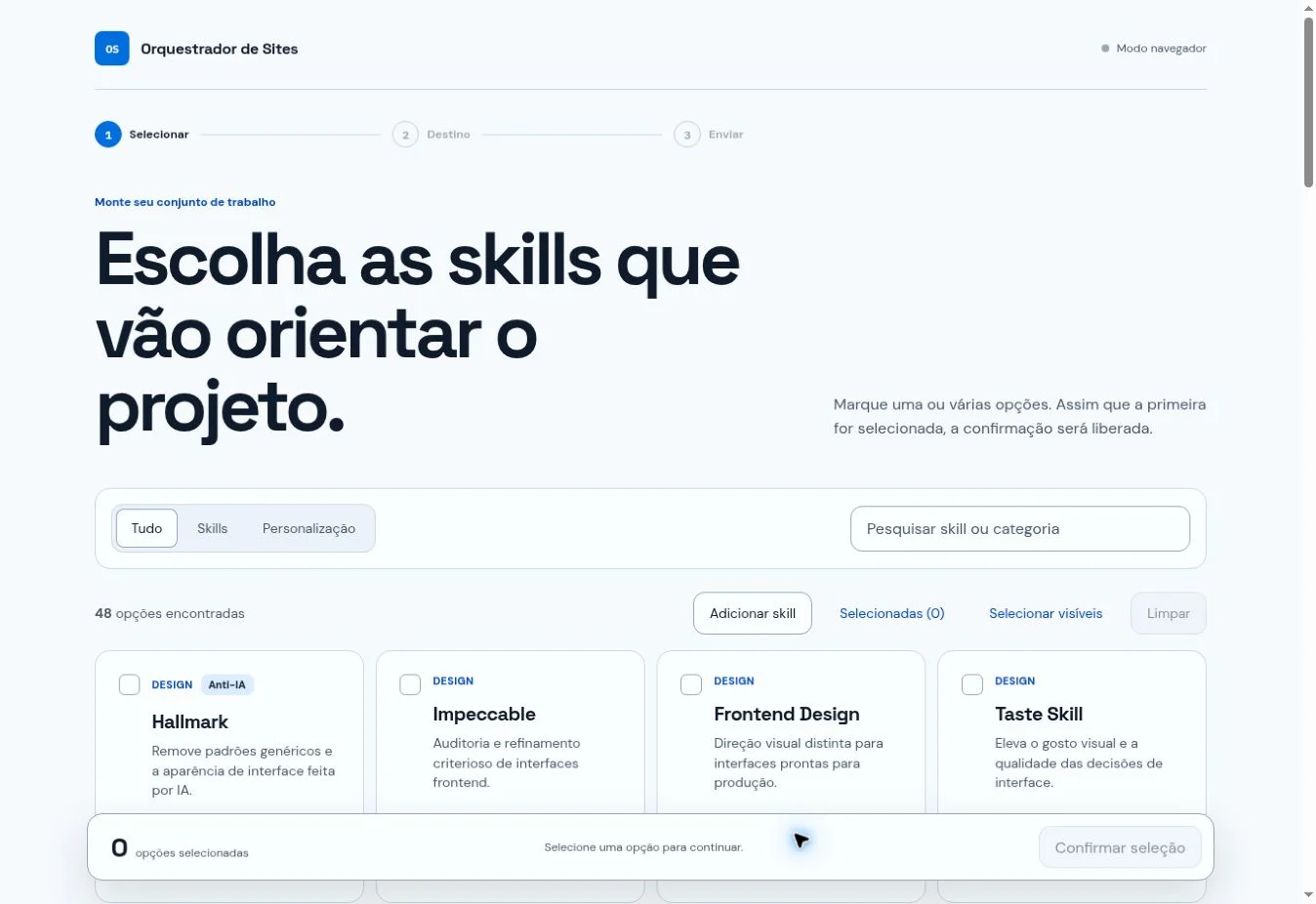
A catalog with search, filters, selection and staged confirmation. Skills and external references have distinct labels.
Original tool · MCP App
I centralized skills and references in a catalog to assemble a working toolkit and bring instructions into a project.
Scattered instructions
Contextual skill selection
Reusable development criteria
Across different projects, selecting instructions, design references and review criteria requires context and repetition. Mixing inspiration links with executable instructions also creates ambiguity about what is being applied.
I created the Orchestrator to bring the working toolkit into a searchable catalog, with selection, confirmation and destination. As an MCP App it brings confirmed instructions into ChatGPT; in the browser it prepares text for the project.
A catalog with search, filters, selection and staged confirmation. Skills and external references have distinct labels.
An MCP endpoint and proposal flow with input and origin validation, Turnstile and submission limits. The GitHub App creates a branch and Pull Request for review.
Brings design, UX, engineering, review, motion, SEO and accessibility together. The catalog contained 48 options across skills and external references.
Includes my PageSpeed & SEO Optimizer, Anti-AI-Slop directive and Website Image Prompts alongside community references.
Personalizations are reference resources, not automatically activated skills. Tests check this distinction in the generated prompt.
Proposals create a branch and Pull Request; input validation, origin checks, limits and Turnstile protect the submission flow.
Documentation of selection, MCP, catalog and contributions.
Validates confirmed instructions, scope and reference separation.
Automated catalog, interface and submission-protection scenarios.
The documented benefit is centralizing and reusing the production process. There is no comparable measurement of time or cost savings. The 48 options include third-party resources; each reference retains its authorship.